


Stocks Lane
Stocks Lane which joins to Summer Lane is located just north of Barnsley town centre.
The first map that indicates any industrial development in Stocks Lane is the 1 to 500 scale Ordnance Survey map surveyed in 1888 and published in 1889. It shows two foundries at the eastern end of the Lane, near to its junction with Summer Lane. During the industrialisation period, as Barnsley town grew due to coal mining, linen weaving and glassmaking industries, the area around here developed as well.

Read on further to discover some of the industrial buildings and landmarks that were once located here:
- Victoria Foundry
- Mona Foundry
- William Sugden and Sons – Empire Mills
- Qualter, Hall & Co. Ltd.
- Summer Lane Station
Victoria Foundry

On the north side of Stocks Lane was the Victoria Foundry, which appears to be the earlier of the two foundries, as it is listed in White and Co’s General and Commercial Directory of Sheffield and surrounding towns, dated 1871-2.
The proprietor was named William Arnold and his entry in the 1879 edition of White and Co’s Directory reads as follows:
Arnold, William, ironfounder, engineer and boiler maker, manufacturer of Arnold’s patent compound half-pressure boiler and patent metallic piston and kitchen ranges, Stocks Lane.
The site of the Victoria Foundry now forms part of the premises of Howarth Timber and Building Supplies.
Mona Foundry
The other early industrial site on Stocks Lane was called the Mona Foundry and stood on the south side, exactly opposite to the Victoria Foundry.
The Mona Foundry was both an iron and brass foundry and was run by John James Kelly.
It is identified on both the 1888-1889 and the 1904-1906 Ordnance Survey maps as an iron and brass foundry and newspaper recrods show that the business went bankrupt in 1907. On the 1932 Ordnance Survey the site is identified as a saw mill, and then on the edition published in 1960 as a warehouse. The site presently forms the eastern end of the premises
William Sugden and Sons – Empire Mills

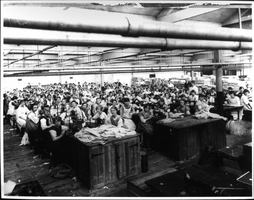
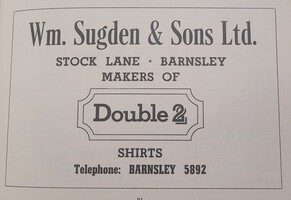
William Sugden started a tailoring business in Cleakheaton in 1869. His sons later joined him, and by 1899, they had established a shirt-making factory there.
The company expanded by opening its second factory at Hope Works on Sackville Street, Barnsley (now the site of Gateway Plaza) in 1904. A third factory opened in Wakefield in 1911.
In 1912, Hope Works factory relocated to a new, purpose-built factory called Empire Mills, situated at the junction of Stocks Lane and Myrtle Street.
A Welfare Club was established by the company in 1919.
In 1968, the Sugden family business merged with the Donner family who owned the Double Two shirt company.
Qualter, Hall & Co. Ltd
Qualter Hall is an engineering firm, initially specialising in mining engineering. The firm’s website lists its current specialisations as ‘Mechanical, Electrical, Instrumentation, Control and Automation (MEICA) services’.
The company dates its evolution from 1860 when a moulder from Droylesden near Manchester named George Bower invented a new type of piston. He joined forces with a blacksmith named John Qualter and an engine fitter named Edward Hall.
The partners moved to Barnsley in 1867 and premises were leased in the centre of town on Midland Street, close to its junction with Eldon Street. At this time George Bower remained as a partner but did not make the move to Barnsley, so a fourth partner with experience as a moulder, John Needham, was brought into the firm.
The reputation and success of the business grew through the 1880s and 1890s, including steam engines for various purposes, colliery headgear pulleys, and then expansion into all forms of colliery plant.
This increase in trade required the expansion of the premises onto the land between Midland Street and the railway station. The expanded premises were named the Railway Foundry (this site is presently occupied by the bus station).
However, by the 1920s a new site was required and in 1928 the firm purchased an existing works off Stocks Lane which then went by the name of the Dominion Works, following the collapse of its former owners, the firm of John Gillott and Sons.
.jpg)

The new premises were approached from Stocks Lane down Johnson Street. The company immediately renamed them as the Railway Foundry, to provide continuity with the former site, and they form the core of the premises that the company still occupies today.
After the move the company extended its manufacturing range and one of its structural steelwork contracts was for a new stand for Barnsley Football Club at Oakwell Stadium in 1931.
During the Second World War, Qualter Hall was involved in the manufacture of parts for the Mulberry Harbours, the portable artificial harbours used by the Allies to land supplies and equipment in Normandy after D-Day. However, as the company history states: “So much secrecy surrounded this project that nobody in the Company had any idea what the equipment was, let alone where it was to be used.”
After the War and during the 1950s, the company continued to innovate in its production of colliery plant and it benefitted from the National Coal Board’s policy of reconstruction of the pits following the nationalisation of the mines.
The premises purchased in 1928 have been expanded several times in an easterly direction and now encompass the areas behind Hilton Street and Darley Terrace and the industrial premises facing onto Stocks Lane itself near its junction with Summer Lane.
Sources of reference:
‘A Handful of History: The Story of Qualter Hall & Co Ltd, 1860-1960’, written and compiled by Philip J. Hall. (Barnsley Archives: SY-94-B/1/1)
Qualter, Hall & Co. Ltd. Company website: https://qualterhall.co.uk/history/
Summer Lane Train Station


In 1848, the Manchester, Sheffield and Lincolnshire Railway obtained approval to build a line from Penistone to Barnsley. However, the company could not begin work due to heavy expenses incurred from constructing the Woodhead Tunnel.
The MSLR only acted on its Barnsley-Penistone plans after the Great Northern Railway, which had no existing line in the town, wanted to launch its own Barnsley-Penistone proposals.
The works started at Penistone and extended east, frequently stopping at a colliery, which enabled revenue to be generated before further tracks were constructed.
After reaching Dodworth colliery, work stopped for a while before Summer Lane station opened as a passenger terminus on 11 November 1855. The station also handled general goods as well as coal. Due to challenging terrain with curves and steep slopes, the MSLR had to take time to plan the best route and opened a goods yard off Regent Street in 1857, which later became part of the Court House Station site by 1870.
Works on the line took another two years to complete before the Barnsley-Penistone passenger service could start.
The Barnsley Co-operative Society established a corn mill, jam factory, distribution warehouses and dairy at Summer Lane which linked to the railway in 1928. This area became known as the Society’s Perseverance Estate. The Society also delivered house coal to domestic homes.
Summer Lane Station closed on 22 June 1959 due to declining passenger use and nationalisation of railway. However, it remained opened for goods traffic until 1971.
Source of reference: Rails Through Barnsley: A Photographic History by Alan Whitehouse, published by Pen & Sword Transport, 2016.

Cresswell Street, Pogmoor

Pogmoor is a residential suburban area located near to Stocks Lane.
In 1942, Sergeant Albert Hollingworth of the Royal Australian Air Force died after steering his failed Whitley bomber into a quarry near Cresswell Street so as to avoid crashing into houses. In 1986, a memorial plaque was made for him and mounted onto one of the houses wall in Creswell Street near the crash site, funded by the Barnsley R.A.F.A., Pogmoor R.B.L. and public donation.
Hollingworth's bravery is remembered in Experience Barnsley Museum. Following the crash in 1942 part of the propeller was salvaged and was donated to the museum and is now on display in the town hall.
